


September 07, 2026
Gaussian Splatting Explained
Gaussian splatting explained: what it is, how it works, and why industries are taking notice.
Gaussian splatting is a 3D visualization method that has attracted growing interest among professionals working with industrial digitalization. Splat rendering offers a way to represent complex environments photorealistically without the limitations of traditional polygon models, and its suitability for reality capture data makes it particularly interesting in industrial environments. In this article, we explain what gaussian splatting means in practice, how it differs from other 3D methods, and why it is emerging as part of the future of the industrial digital twin.
How splat rendering differs from traditional 3D methods
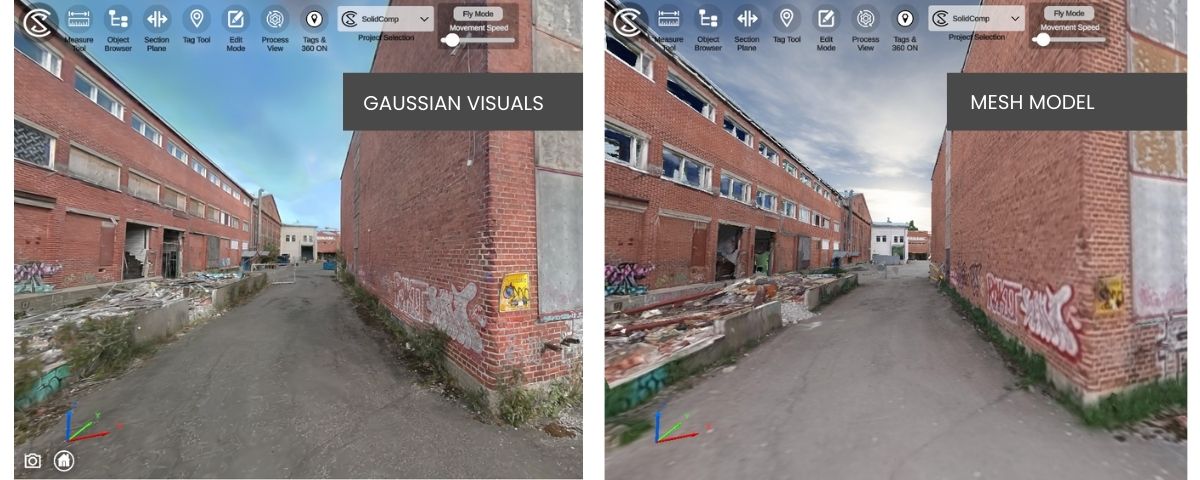
Traditional 3D visualization methods are built on either polygon meshes or point clouds. A mesh model consists of triangles or other polygons that form a surface, and it often requires a significant amount of manual modeling work before the result looks realistic. A point cloud, on the other hand, is accurate and dimensionally precise, but its direct visualization does not produce a photorealistic image without additional processing.
Splat rendering approaches the problem from a different angle. Instead of building geometry from surfaces or points, the environment is represented as millions of small, semi-transparent ellipsoids — or “splats” — each carrying information about position, size, orientation, and color. The result is visually rich and natural to the eye, and does not require a separate surface model. This makes gaussian splatting particularly attractive in situations where a fast and accurate visual representation is more important than editable geometry.
How gaussian splatting works in practice
Gaussian splatting is based on the 3D Gaussian Splatting method, which uses photographs or other image data as source material. Algorithms fit three-dimensional Gaussian distributions to the images, describing how light and color are distributed at different points in space. Each splatting ellipsoid is therefore a mathematical estimate of what a particular point in the environment looks like from different viewing directions.
Once the model has been optimized, it can be rendered in real time on a standard graphics processor. The user can move freely through the space, and the view updates smoothly as the viewing angle changes. This real-time capability sets gaussian splatting apart from, for example, traditional photogrammetry, whose mesh models often require a heavy rendering process before the final image is produced. In a practical workflow, a splat model can be produced in a reasonable amount of time if the source image material is of high quality and comprehensive coverage.
Suitability for industrial environments and reality capture data
Industrial environments are demanding subjects for any 3D documentation method. Pipelines, structures, equipment, and confined spaces create a geometrically complex whole in which both visual accuracy and dimensional precision are important. Gaussian splatting is particularly well suited to situations where the goal is to produce a visually convincing representation of an existing facility quickly and without extensive modeling work.
Reality capture encompasses the methods by which a physical environment is recorded in digital form. Laser scanning produces dimensionally accurate point cloud data, while photogrammetry and image-based reconstruction are well suited as source material for gaussian splatting. These methods complement each other: laser scanning ensures dimensional accuracy and the point cloud, while image data enables photorealistic splat visualization. Combined, they form a comprehensive foundation for the industrial digital twin.
However, it is worth recognizing the limitations of gaussian splatting in industrial use. The method does not directly produce dimensionally accurate geometry in the same way as laser scanning, and it does not replace a point cloud or mesh model in situations where precise measurements or clash detection are required. Splat rendering complements other methods as a visual layer — it does not replace them.
Gaussian Visuals as part of the Reality Twin ecosystem
SolidComp’s Gaussian Visuals is an add-on service for the Reality Twin platform that brings photorealistic visualization into the industrial digital twin. It leverages gaussian splatting technology to produce a visually accurate representation of a production facility that can be viewed in a browser without separate software installations.
In practice, this means that a designer, maintenance manager, or project manager can view the facility as a photorealistic scene directly within the Reality Twin service — in the same environment where all other facility data resides. The visual representation is built on top of genuine reality capture data, so it reflects the actual state of the facility rather than design assumptions. This supports more accurate work planning and reduces the need for site visits, particularly during the pre-planning phase.
Development directions for gaussian splatting in industry
Gaussian splatting is still a relatively young method, but its development has been rapid. By 2026, the method has moved from research laboratories into practical applications, and its potential as part of digital workflows is being actively tested across multiple industries. From an industrial perspective, the most interesting development directions include improved dimensional accuracy, better compatibility with laser scanning data, and lighter file sizes that enable large facilities to be presented smoothly even on mobile devices.
Another significant direction is integration with existing information systems. When splat visualization can be linked by location to asset data, maintenance systems, or documentation, what was once a purely visual representation becomes a functional tool. In this development, reality capture data and the digital twin form a natural foundation on top of which photorealistic visualization adds value without requiring separate systems. Gaussian splatting is therefore not a standalone solution, but part of a broader industrial data ecosystem built on the foundation of accurate measurement data.