



September 07, 2026
Digital Twin Maturity Levels: From Passive to Autonomous
Digital twin maturity levels explained: where to start and how to progress toward autonomous analytics.
The digital twin is a concept that generates a great deal of interest in industry, but also considerable confusion. One production facility may refer to a simple 3D model as its digital twin, while elsewhere the same term encompasses a real-time, integrated system that drives maintenance decisions. This difference is not merely technical – it directly affects what business benefits can realistically be extracted from a digital twin.
Digital twin maturity levels describe this development arc, from passive documentation toward autonomous, predictive analytics. Identifying the maturity level helps a production facility make better investment decisions and plan a development path that reflects genuine operational needs rather than technology for its own sake.
Five Maturity Levels: Passive > Autonomous
Industrial digital twin maturity is not a yes-or-no question, but a continuum. In the framework, levels progress from zero to five, and each level adds both data depth and operational value.
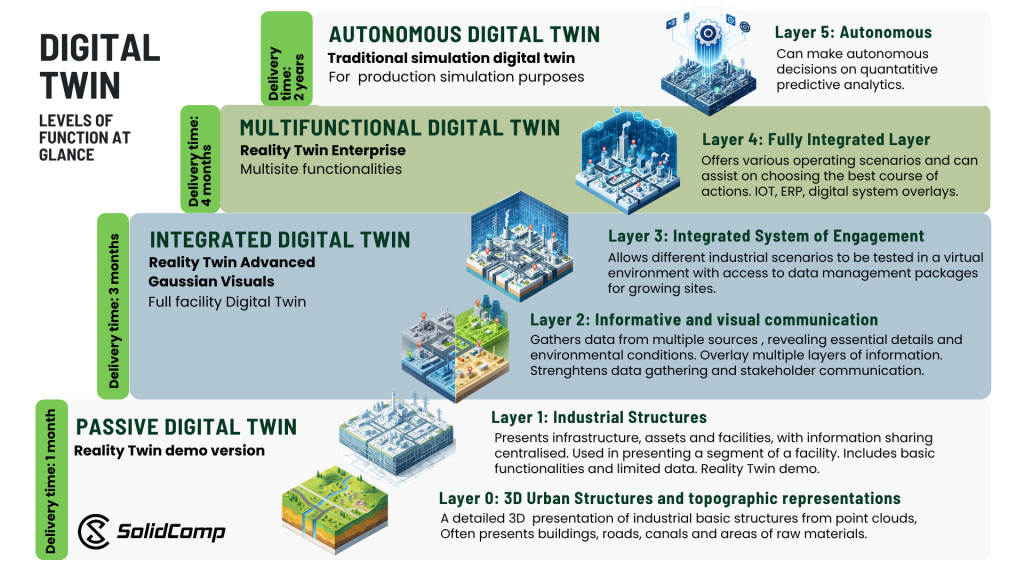
Level 0 covers 3D terrain and infrastructure structures, such as site maps and general spatial models. This is the starting point, where digitalization exists primarily in documentation form. Level 1 is the passive digital twin: a laser-scanning-based 3D representation of the facility that reflects reality rather than design assumptions. It is static, but already valuable as a source of information for planning and risk management.
Level 2 introduces an informative and visual communication layer. Documents, drawings, and equipment data are linked alongside geometric data, making facility information discoverable by location. Level 3 is an integrated service in which the digital twin reads data from the customer’s existing systems — such as SAP or IBM Maximo — into a location-based 3D view. At this level, maintenance history, work orders, and equipment data are accessible directly from the facility model.
Level 4 is a multifunctional environment in which multiple sites or different teams within an organization share a common digital twin. Collaboration, information sharing, and decision-making accelerate when everyone has access to the same up-to-date facility data. Level 5 is the autonomous digital twin, which leverages predictive analytics and learns from facility data. This level is the long-term goal of industrial digitalization, but achieving it requires significant data maturity and a high degree of integration from the earlier levels.
How Maturity Level Affects Business Benefits
Maturity level directly determines what business benefits can realistically be obtained from a digital twin. Even the passive level has its value, but the scope and depth of benefits grow significantly as the degree of integration increases.
At levels 1 and 2, the greatest benefits arise in the areas of project planning and safety. When facility geometry is based on actual laser scanning rather than outdated drawings, clash detection is reliable and fieldwork planning is safer. In shutdown projects, this means fewer surprises and shorter planning time.
From level 3 upward, benefits begin to show in maintenance efficiency and operational decision-making. When maintenance history is linked to equipment location in the 3D model, fault localization and repair planning become faster. According to estimates reported by customers, this can mean decision-making that is up to approximately 80 percent faster and operational costs that are approximately 19 percent lower. These are benefits projected by customers, not absolute guarantees, but they reflect real operational changes.
At the autonomous level, benefits shift from reactive maintenance to predictive maintenance. The facility no longer merely documents the past, but identifies anomalies and suggests actions before failures occur. This represents a significant change from both a cost and a production continuity perspective.
Assessing the Starting Point: Where the Production Facility Stands Today
Before a development path can be planned, the starting point must be identified honestly. Many facilities assume they are at a higher maturity level than they actually are, because digital tools are in use but they do not communicate with each other, or their data does not reflect the current state of the facility.
In a practical assessment, it is worth asking a few concrete questions. Does the facility have an up-to-date 3D model based on measured data rather than design drawings? Is equipment and documentation information discoverable by location? Is the maintenance system integrated with facility data? How many separate systems does a field worker need in order to access the information they require?
If the answers reveal that information is scattered across multiple systems and the facility geometry is not current, the facility is most likely at level 0 or 1. This is not a problem – it is a starting point. The most important thing is to recognize it realistically, so that development steps can be sized correctly.
Raising the Maturity Level as a Phased Development Path
Raising the digital twin maturity level does not require a large one-time investment. A phased approach is a more sensible way to proceed, both from a risk management and an organizational learning perspective.
A good starting point is a comprehensive laser scan of the facility, which creates a reliable geometric foundation for all subsequent development. Millimeter-level measurement accuracy means the investment is a one-time effort: the same data can be used in planning, maintenance, and safety reviews for years to come. Mobile laser scanning makes it possible to cover larger areas significantly faster than traditional static scanning.
The next step is linking documentation and equipment data to the geometric model. At this stage, the digital twin begins to serve day-to-day work, not just planning projects. Reality Twin is built precisely for this purpose: it brings together scan data, 3D models, and operational data into a single shared view without requiring existing systems to be replaced.
Increasing the degree of integration – that is, moving to levels 3 and 4 – happens most naturally by phasing system integrations according to business priority. The maintenance system is often the first integration target, because that is where the operational benefit is most immediate. Pursuing the autonomous level is a realistic long-term direction, but it requires that the data from earlier levels is of high quality and comprehensive.
Raising the maturity level is above all an organizational change, not merely a technical one. Teams need new ways of working, and maintaining data quality requires ongoing attention. The development path is best planned together with a partner who understands both the operational realities of industry and the practical challenges of building a digital twin.