


May 18, 2026
Avoid These Pitfalls: What Is Often Underestimated When Procuring Digitalisation Projects
In laser scanning and digitisation projects, the goal is to produce data from the physical environment that is as accurate, usable and as long-lasting as possible. Often, the project proceeds smoothly and even faster than estimated. However, it is normal that not everything always goes exactly according to the original plan.
Industrial environments are complex, work sites change, and there may be uncertainties in the initial information. This is why a successful digitalisation project is not based only on good measurement equipment, but also on project planning, flexibility, safe fieldwork and clear communication between the customer and the service provider.
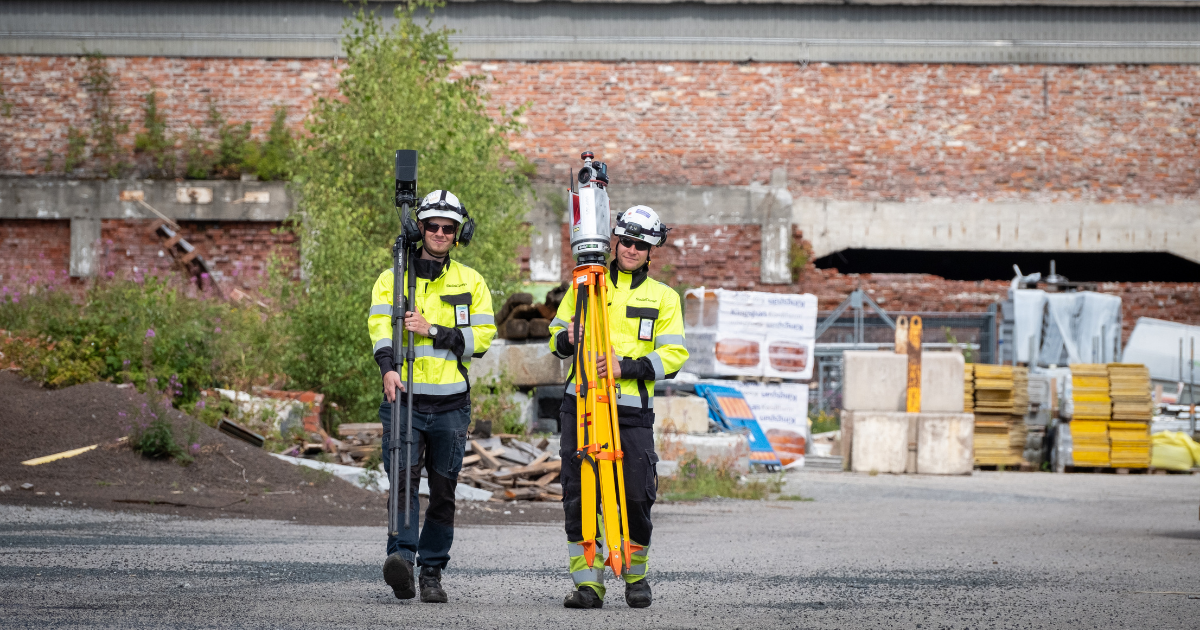
At SolidComp, projects are carried out by sales specialists, project leads and laser scanning professionals who have experience not only in scanning, but also in working safely and effectively in different industrial and construction environments. The work is always carried out in accordance with general safety regulations, site-specific instructions and the requirements of the project in question.
Below, we have gathered common points that the buyer should take into account when planning a laser scanning or other digitalisation project.
The Schedule Does Not Depend Only on the Number of Square Metres to Be Scanned
One of the most commonly underestimated factors is the time required for the work. The duration of scanning cannot be estimated based on floor area alone, because the shape of the site, visibility, number of levels, amount of equipment and required accuracy all have a significant impact on how many scanning stations are needed.
If sufficient equipment is available and the site is well prepared, scanning can often be completed even faster than estimated. On the other hand, the schedule may change if the customer wants to add new areas to the project during the work, or if the original scanning need has been underestimated.
For example, a single room does not necessarily mean a single scanning position. If the data needs to be tied to a coordinate system and blind spots need to be minimised, the same space may require several scanning stations. In practice, one room may require, for example, five stations if visibility is limited or the space contains many structures, pieces of equipment or levels.
This is not a mistake in itself, but a normal part of the reality of scanning projects. Good advance planning helps estimate the scope of work, but in the field, the site often reveals its final requirements.
The Accuracy of Initial Information Affects the Scope of Work
Another common challenge relates to how accurately the need and the site have been described before the project begins. If the initial information is, for example, “we only need one 500-square-metre space”, the estimate may look simple. On site, however, it may turn out that the space has five service levels, a large amount of equipment, pipework or structures that block visibility and increase the number of scanning stations required.
In such a situation, the original workload estimate may change even if the floor area itself has not increased. In scanning, what matters is not only the size of the area, but also what is located in the area and how comprehensive the data needs to be.
The service provider may also estimate the scanning requirement incorrectly if the initial information is incomplete or if the true complexity of the site is not apparent from it. In a professional project, however, this is taken into account. The workflow can be adjusted in the field, the scanning plan can be refined, and additional work can often be fitted into the same scanning days.
Flexibility does not remove the need for good initial information. The more accurately the site structure, intended use, critical areas and expected outcome are described in advance, the more likely it is that the schedule, costs and delivered data will meet expectations.
Additional Areas Can Affect Costs
In some projects, costs may come as a surprise to the customer. This is often because, in the field, a decision is made to scan additional areas that were not included in the original offer or workload estimate.
Measuring additional areas may be entirely sensible. When the scanning equipment and specialists are already on site, it can be efficient to document adjacent spaces or areas that may be relevant for future projects at the same time. At the same time, it is important to recognise that additional work usually also affects costs.
This is why the customer’s internal communication is important. It is useful to ensure already before the project that the people responsible for defining the need and the people responsible for the project budget are aligned. This prevents changes made in the field from becoming a surprise to decision-makers only at the invoicing stage.
A clear operating model helps both the customer and the service provider: who can approve additional areas, how they are agreed, and how the impact on schedule or costs is handled.
The Characteristics of the Ordered Data Should Be Understood in Advance
In digitalisation projects, it is important that the customer has a clear understanding of what has been ordered and what kind of end result can be expected from the chosen method.
For example, if the customer has been shown a photographic combined model using laser scanning and the Gaussian Visuals view, the result will look very different from data based only on mobile scanning. Mobile scanning can be a fast and appropriate way to document large spaces, but its visual quality and accuracy do not match data produced with a tripod scanner or a photographic Gaussian view.
Disappointment can arise if the example data shown during the sales phase and the product ultimately ordered do not correspond to each other. This is why it is important to discuss already at the beginning of the project whether the primary need is measurement accuracy, a quick general overview, visually impressive material, source data suitable for design, or a combination of these.
SolidComp’s specialists help clarify the characteristics and limitations of different options. If the customer is unsure which type of data best suits their intended use, this should be discussed before work begins. The right choice always depends on how the data will be used after the project.
The Situation on Site Can Change During the Work
Access to scanning locations is one practical factor that can affect the schedule. In industrial environments, work is often ongoing, areas may be closed for safety reasons, and production or the work phases of other contractors may limit movement.
If an area cannot be accessed as planned, the project does not necessarily stop. Often, other areas can be scanned first and it can be agreed that the inaccessible area will be documented later. A return visit or supplementary visit is not an exceptional failure, but a normal part of practical implementation in many sites.
Working in the field also requires the ability to take into account the site’s safety regulations and the current work situation. Laser scanning specialists must know how to move in different types of work sites and adapt their own work to other activities. This is particularly important in locations with production operations, maintenance work, high places, confined spaces or access restrictions.
Good Cooperation Reduces Uncertainty
A successful digitalisation project is rarely created by technical execution alone. It also depends on how well the customer and the service provider can plan, communicate and respond to changes together.
The first project should already be carried out on the basis of mutual trust. The customer provides the initial information, describes the need and grants the specialists access to the site. The service provider, in turn, estimates the work, plans the implementation, works safely on site and delivers the data in the agreed format.
When the customer relationship continues, cooperation usually deepens. The service provider gets to know the site, the customer’s operating methods and the intended uses of the data. This speeds up future projects, makes task planning easier and improves the accuracy of cost estimates.
Long-term cooperation also helps determine how scanning data should be maintained and supplemented over time. When previous data, the coordinate system and the site’s specific characteristics are already familiar, new scans and updates can be carried out more efficiently.
Customer Needs Can Also Guide Further Development
Digitalisation projects do not always end when a point cloud or model is delivered to the customer. During or after a project, new use cases are often identified: the data may be needed for maintenance, design, safety work, training or sharing information with different stakeholders. We therefore recommend assessing the potential need to deploy the digital twin platform Reality Twin as part of the digitalisation project. A visual 3D model that accurately represents the production facility creates a wide range of new ways to use the data.
Customer experiences and needs can also influence how the Reality Twin environment or related functionalities are developed. Needs identified in practical work are valuable, because they show how digital data is intended to be used in real industrial environments.
A good connection with the provider of laser scanning and digital modelling services is therefore an advantage. It supports not only the success of an individual project, but also the ability to gain more long-term value from the data.
Careful Defining Makes the Project Smoother
In a laser scanning or digitalisation project, there is no need to fear that every detail is not perfectly known at the beginning. Changes, additions and refinements are common, especially in complex industrial sites.
Even so, certain matters should be defined as clearly as possible before the work begins:
- what area will be scanned
- what the data will be used for
- what level of accuracy is required
- what kind of visual outcome is expected
- who can approve additional work
- what restrictions may apply on site
When these matters are discussed in good time, the project proceeds with greater certainty. Schedules and costs become more predictable, the end result better matches the intended use, and changes made in the field can be handled in a controlled way.
Success in a digitalisation project does not mean that nothing changes along the way. Often, success means precisely that changes are anticipated, communicated clearly and managed so that the final outcome serves the customer’s real need.
Subscribe to SolidComp’s Newsletter
Receive a newsletter from SolidComp about once a month. In it, we share the latest updates from the industry, SolidComp, and the SolidComp Reality Twin.
Subscribe newsletter