


September 14, 2026
Laser Scanning and Reality Twin Support Data Centre Construction and Secure Operations
Answering to the challenge of securing reliable site information through construction, commissioning, handover, maintenance and future expansion.
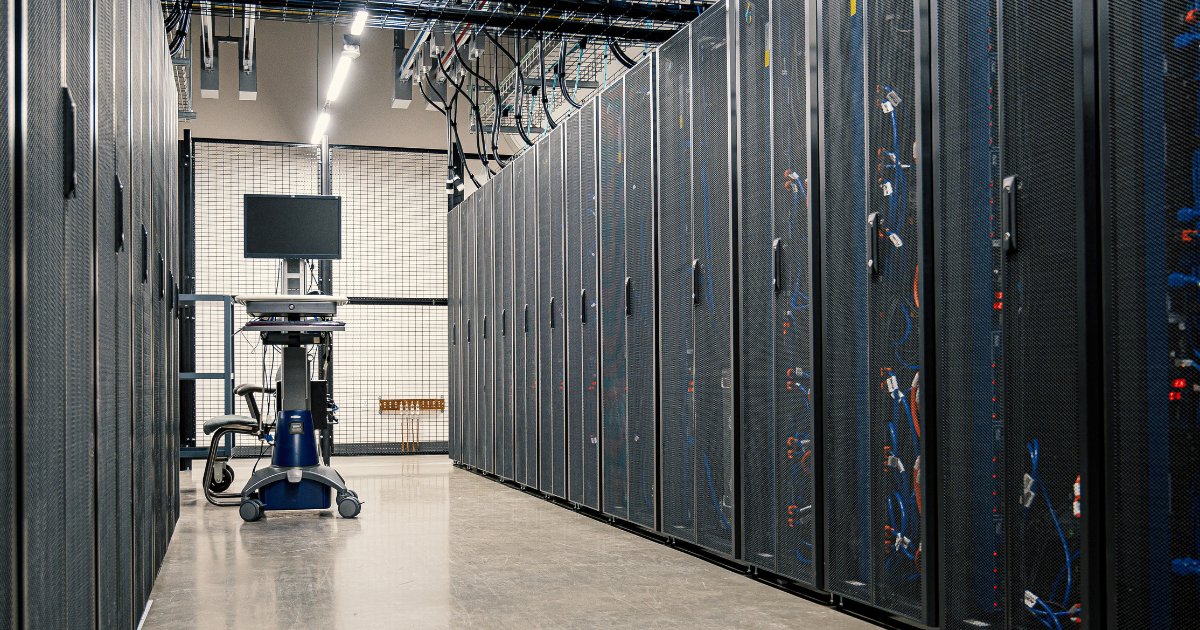
Data centre construction is becoming one of the most demanding areas of industrial project delivery. Facilities must be built quickly, safely and accurately, while power distribution, cooling systems, cabling, fire protection, security zones, structural elements and access routes all need to fit together without late-stage surprises.
For owners, developers, EPC companies, MEP contractors and engineering teams, the challenge is no longer only how to design a data centre. It is how to keep reliable site information available through construction, commissioning, handover, maintenance and future expansion.
SolidComp supports data centre projects with industrial laser scanning, 3D documentation and Reality Twin. Together, they provide a reality-based visual environment where measured site data, 3D models, 360-degree images, documentation and asset information can be used throughout the data centre lifecycle.
Data centres are now a critical topic in Finland
The current discussion around data centres in Finland is strongly linked to AI growth, power availability, grid capacity, waste heat recovery, sustainability, security and local economic impact. Finland is attractive for data centre investments because of its stable operating environment, strong engineering expertise, connectivity, cool climate and access to low-carbon energy. At the same time, new projects are increasingly assessed by how well they fit into the local energy system and how responsibly they can be built and operated.
For parties planning or procuring data centre projects, this changes the practical requirements for suppliers. Project teams need partners who can work quickly, document technical spaces accurately, support multi-party coordination and provide secure ways to share verified information. Search terms such as data centre laser scanning, data centre MEP coordination, as-built documentation for data centres, data centre digital twin, data centre construction subcontractor and data centre commissioning documentation are likely to become more relevant as the market develops.
Verified 3D data reduces uncertainty before construction decisions are made
Data centres are dense technical environments. Even small spatial conflicts between cable trays, switchgear, cooling equipment, pipes, ducts, containment systems, fire protection routes or maintenance access zones can affect the schedule, cost and long-term maintainability of the facility.
Laser scanning creates accurate as-built data of the real site. It helps project teams confirm actual conditions before decisions are made, compare design intent with installed reality and reduce the need for repeated verification visits. This is valuable during new construction, brownfield expansion, retrofit work and phased capacity upgrades.
For design and construction teams, measured point clouds and 3D models provide a reliable basis for MEP coordination, constructability reviews, installation planning and clash prevention. The same data can also support subcontractor alignment when several disciplines need to work in the same areas under tight schedules.
Laser scanning as a turnkey service for data centre projects
SolidComp provides laser scanning and 3D documentation as a turnkey service. The delivery can include project planning, site scanning, coordinate measurement, point clouds, 3D models, 360-degree images, post-processing and agreed delivery formats. The scanning method is selected according to the project phase, required accuracy and intended use of the data.
In data centre projects, the most effective result often comes from combining several methods. Traditional tripod laser scanning can provide high-accuracy data for technical rooms and critical equipment areas. Mobile laser scanning can document larger areas and routes efficiently. Drone imaging and photogrammetry can support external areas, roofs and surrounding infrastructure. Coordinate and control point measurement helps ensure that datasets can be aligned and updated later.
This makes laser scanning useful before design work, during construction, before commissioning, at handover and before future expansion or retrofit projects. When scanning is planned with the full lifecycle in mind, the data does not remain a one-time project file. It becomes a long-term operational asset.
Reality Twin supports commissioning and handover
Commissioning and handover are information-heavy phases. Documentation, asset information, installed conditions, access routes, safety requirements and maintenance needs must be understood by several stakeholders at the same time. If this information is fragmented across drawings, folders, photographs and separate systems, decisions become slower and the risk of misunderstandings increases.
Reality Twin gives data centre teams one visual environment where measured site data, 3D models, 360-degree images, documentation and asset context can be viewed together. It helps owners, contractors, consultants and site teams understand where information belongs in the real facility.
For commissioning, this can support installation verification, documentation handover, equipment location, service route checks and remote reviews. For future operations, it can help teams find the right area, asset, document or spatial context faster without relying only on memory, outdated drawings or repeated site visits.
A digital twin for maintenance, upgrades and secure operations
A data centre digital twin should not be useful only during construction. When the model is planned for long-term use, it can support maintenance, security, training, capacity changes and future development.
Reality Twin can help operations and maintenance teams understand equipment locations, service routes, access constraints and documentation context. It can support safer planning of work in technical spaces and make information easier to share between operations, maintenance, facility, security and external partner teams.
Reality Twin does not need to replace existing systems such as DCIM, BMS, CMMS, document management or asset management tools. Instead, it can act as a visual operational layer that helps teams understand where information belongs in the real facility. The scope of integrations and data visibility can be defined according to the customer’s requirements.
Information security is part of the procurement decision
Data centre projects often include strict requirements for information security, access management, data location and supplier reliability. Industrial 3D data can contain sensitive information about building structures, equipment, technical systems, access routes, security zones and safety-related details. This is why data security must be considered from the beginning.
SolidComp’s Reality Twin can be implemented according to customer requirements, including environments where public cloud alone is not an acceptable option. For high-security environments, Reality Twin can be operated within the customer’s own IT infrastructure as an on-premises solution. This gives the customer stronger control over data storage, access rights, network architecture and the technical boundaries of the operating environment.
SolidComp is also developing and operating its information security processes in line with ISO/IEC 27001 requirements. For customers, ISO/IEC 27001-compliant ways of working support supplier evaluation, risk management and cooperation in projects where information security requirements are strict.
What SolidComp can offer data centre projects
SolidComp can support data centre owners, developers, EPC companies, MEP contractors, engineering offices and operations teams with a practical end-to-end service model. The same partner can deliver high-quality laser scanning and bring the data into Reality Twin when needed.
Typical support includes laser scanning before expansion or retrofit projects, as-built documentation for technical rooms and external areas, MEP coordination for power distribution and cooling systems, construction progress documentation, remote project reviews, commissioning and handover support, maintenance access checks and secure visual data environments for technical stakeholders.
Speed is also important. SolidComp is used to delivering industrial scanning and Reality Twin projects in demanding environments, with clear project planning, efficient fieldwork and practical post-processing. This helps project teams get usable data quickly instead of waiting until the information is already outdated.
Read more
Subscribe to SolidComp’s Newsletter
Receive a newsletter from SolidComp about once a month. In it, we share the latest updates from the industry, SolidComp, and the SolidComp Reality Twin.
Subscribe newsletter