


June 15, 2026
Reality Twin Customer Survey: Reducing Site Visits and Saving Time Deliver the Greatest Value
In SolidComp’s customer survey, users highlighted practical day-to-day benefits as the most valuable aspects of Reality Twin. Time savings, reduced site visits and improved understanding of facilities emerged as the strongest themes. Customers also expressed growing interest in future integrations and AI-assisted information retrieval.
In Industrial Environments, the Challenge Is Not a Lack of Information – It Is Finding the Right Information
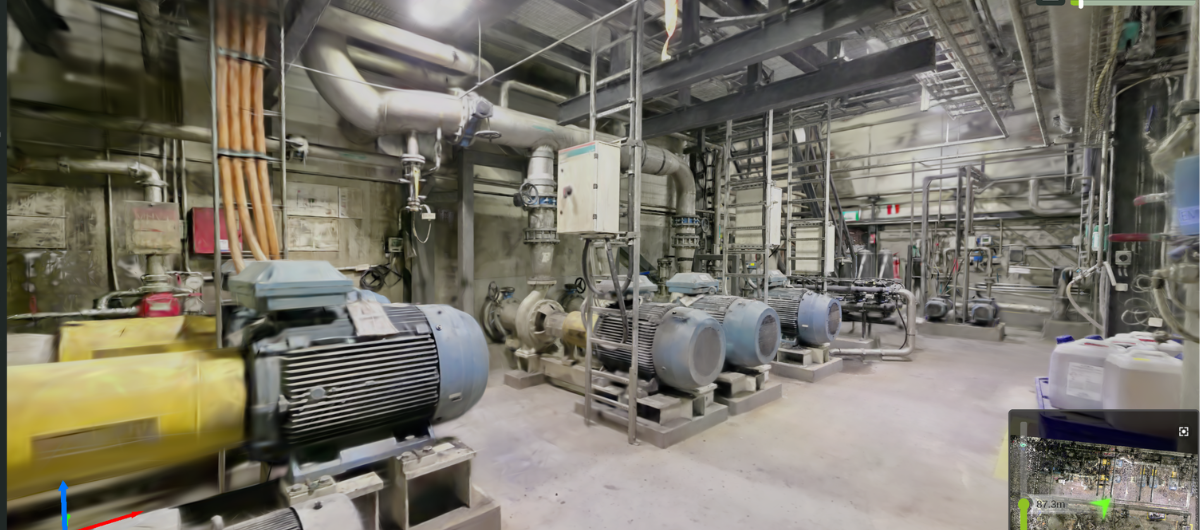
Industrial facilities generate vast amounts of information. Some of it resides in engineering models, some in documents, some in maintenance systems and some only in the experience of long-serving employees. When a project, shutdown, modification or maintenance task begins, the first challenge is often ensuring that everyone is working from the same understanding of reality.
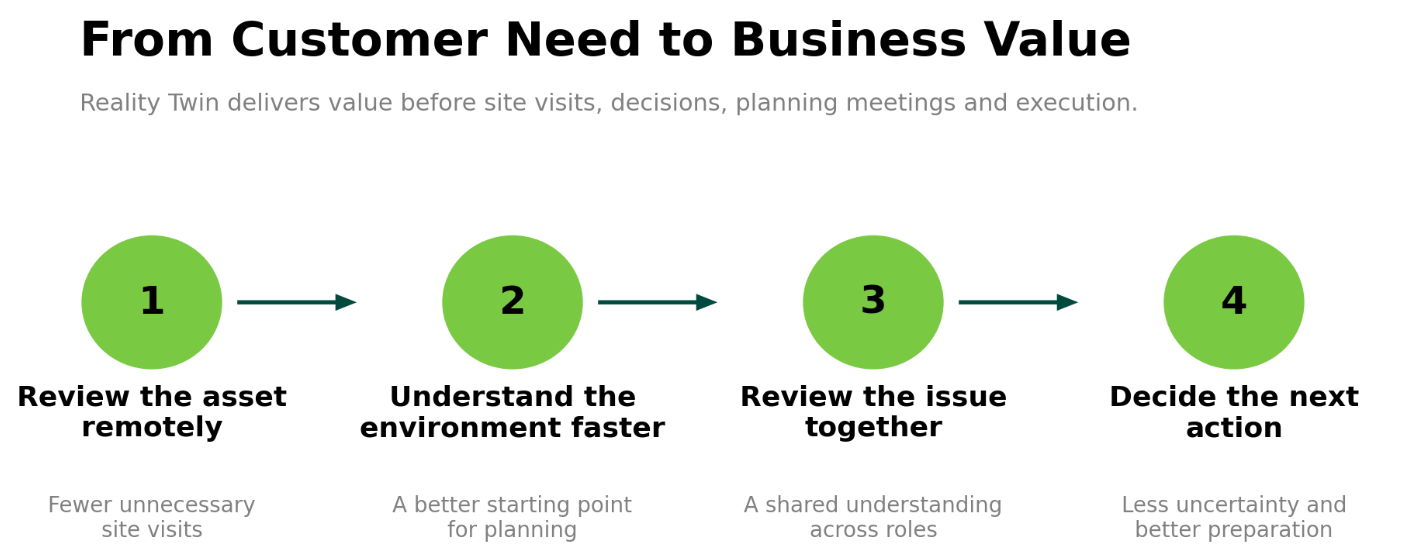
The results of our major customer survey conducted in spring 2026 suggest that Reality Twin serves precisely this purpose. Users can view the same asset, the same environment and the same working conditions before making decisions or travelling to site. For smaller checks, a site visit may not be required at all.
Customer-Reported Benefits of Reality Twin
Reducing Physical Site Visits Was the Strongest Customer Signal
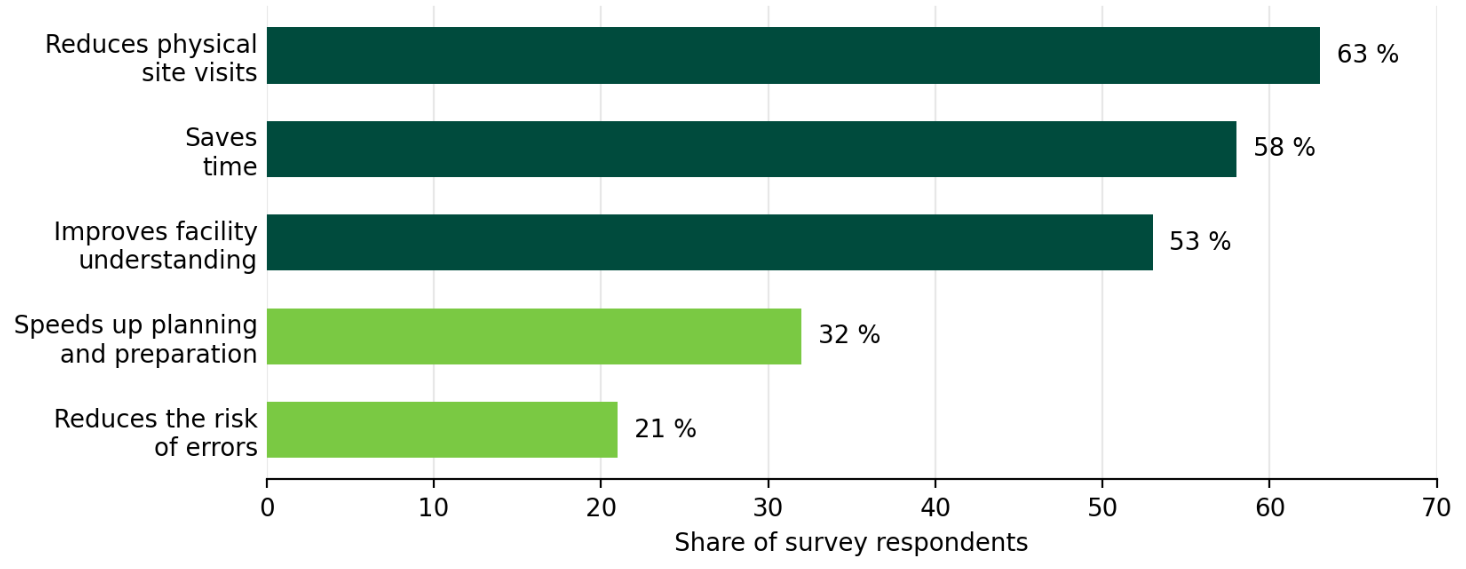
Approximately 63% of respondents identified reduced physical site visits as one of the key benefits of Reality Twin.
The result suggests that users see Reality Twin as a tool for preparing work before investing time in travel, permits, safety procedures, escorts and preliminary inspections on site.
This matters because time spent travelling is time taken away from other work. More importantly, every avoidable site visit interrupts workflows, ties up experts and slows progress. If some inspections and assessments can be completed remotely, organisations gain a faster starting point for projects, maintenance planning and modification work.
Reality Twin is not intended to replace site visits. Instead, it supports proven working practices and existing workflows. When users can review routes, structures, equipment locations, space reservations and potential challenges beforehand, they arrive on site better prepared.
Time Savings Come from Everyday Situations
Around 58% of respondents associated Reality Twin with time savings.
While time savings can sometimes come from major technological breakthroughs, they are more often achieved through small but frequent improvements. A planner needs baseline information, a project manager wants to verify a location or a maintenance team is preparing work. When these routine activities become faster, the cumulative impact becomes significant.
Reality Twin provides a shared visual starting point. When a facility can be reviewed during a meeting, project review or planning session, participants no longer need to build a mental picture from fragmented information sources. A shared view accelerates discussions and reduces the risk of misunderstandings.
Better Situational Awareness Improves Decision-Making
Approximately 53% of respondents highlighted improved understanding of facilities and environments.
In industrial settings, the quality of decisions often depends on how well people understand the physical environment. Drawings, photographs and individual documents do not always reveal how equipment, pipework, structures, routes and work areas relate to one another.
This is important because unclear situational awareness can lead to incorrect assumptions. A plan may appear sound on paper, only for unexpected space constraints, obstacles, safety concerns or interpretation differences to emerge in the field. Resolving these issues later consumes time and can affect project outcomes.
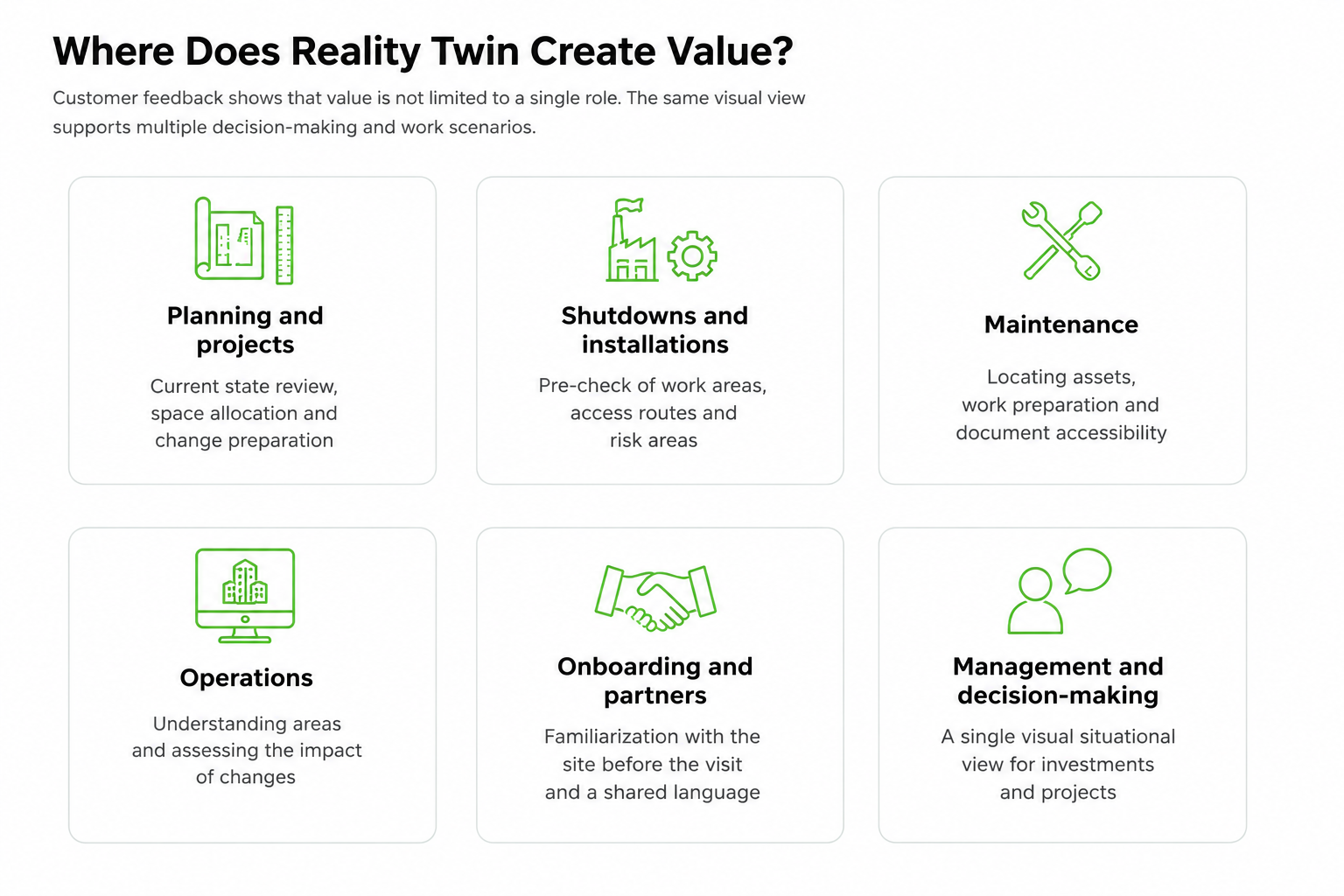
Reality Twin brings the physical environment into the centre of decision-making. It provides production teams, maintenance personnel, designers, project managers and external partners with a shared visual understanding of reality. This does not replace expertise; it helps organisations apply it more effectively.
Faster Planning and Preparation Create Business Value
Around 32% of respondents reported that Reality Twin helps accelerate planning and preparation.
When existing conditions, structures and facilities can be reviewed visually, planning activities can begin sooner and with greater confidence in the available information.
Incorrect assumptions made during the early stages of a project often become costly because they affect design, procurement, scheduling and implementation. Identifying uncertainties earlier allows organisations to make better decisions and allocate budgets more effectively.
Reality Twin supports this particularly when used at the very beginning of a task. It is most valuable before the first planning meeting, before a site visit and before external designers or contractors begin evaluating a facility.
Reducing Errors and Uncertainty Supports Risk Management
Approximately 21% of respondents mentioned reduced risk of errors.
In industrial environments, even small misunderstandings regarding location, space availability, structures or work areas can result in delays, additional investigations or changes during implementation.
For decision-makers, the key question is how uncertainty can be reduced before work moves into execution. The earlier a shared visual understanding is established, the better organisations can manage schedules, safety, costs and operational efficiency.
Reality Twin helps make complex environments visible. When the same facility can be shown to all stakeholders, discussions shift from assumptions to observations. This is particularly valuable in projects, shutdown planning, modification work and collaboration with external partners.
The Next Layer of Value Comes from Connecting Visual Models with Documents and Asset Information
Approximately 32% of respondents identified document management integration as an important future development area.
Once users locate the correct asset, the next question is often: what information is associated with it? Where are the relevant documents, drawings, asset records, work instructions and maintenance information?
It is clear that the accessibility of facility information directly affects productivity. When technical information is difficult to locate, users must move between systems and manually verify that the information relates to the correct asset. This slows work and increases the risk of misinterpretation.
This challenge can be addressed by connecting Reality Twin to existing information sources. When users can locate an asset visually and access related documentation within the same context, Reality Twin becomes a gateway to information maintained across multiple systems.
The Most Valuable Role for AI Is Helping Users Find the Right Information
Based on customer feedback, the primary role of Reality Twin AI should be to support everyday work by helping users locate the correct equipment, asset location, pipeline, document or work instruction more quickly.
This represents a practical and credible AI use case for industrial environments.
The first objective of Reality Twin AI is therefore to make facility information easier to utilise. Users should not need to know which system contains the information or what exact terminology is required to find it. Instead, they should be able to describe what they need and be guided to the correct asset or document more efficiently.
We expect to publish the first concrete results from our AI pilots during the second half of 2026.
Why Does This Matter Now?
Digital twins are often discussed as large technological initiatives involving data, integrations and phased implementation programmes.
From the customer’s perspective, however, value must be demonstrated in everyday work.
The feedback received from Reality Twin users reflects this reality. The greatest value first emerges in practical situations: reviewing facilities, preparing work, understanding existing conditions and creating a shared understanding of the environment. Once this foundation is in place, the next layer of value comes from connecting information sources: documents, asset records, equipment data, work instructions, maintenance information and eventually AI-assisted search capabilities.
Reality Twin should therefore be understood first and foremost as a practical tool that reduces uncertainty before decisions are made, before personnel are sent to site, before design work begins and before a shutdown is planned.
Assess the Benefits of Reality Twin in Your Own Facility
The best way to evaluate the benefits of Reality Twin is to select a real use case—an asset, project or process that currently requires significant time for review, planning or preparation.
Contact us to learn more about the Reality Twin Starter Package and discuss how Reality Twin could support your operations.
Contact uss
Subscribe to SolidComp’s Newsletter
Receive a newsletter from SolidComp about once a month. In it, we share the latest updates from the industry, SolidComp, and the SolidComp Reality Twin.
Subscribe newsletter